

Why Jigsaw Puzzles May Support Brain Health and Healthy Aging: An Occupational Therapist’s Perspective
Paid Partnership + Affiliate Disclosure: This article was created as part of my paid partnership with Completing the Puzzle. It also contains affiliate links. If you make a purchase through my link or use my discount code PUZZLEOT, I may earn a commission at no additional cost to you. All opinions and recommendations are my own.
Many people think jigsaw puzzles are simply a relaxing hobby or a way to spend a rainy afternoon. While they certainly provide enjoyment, they may also support brain health and encourage healthy aging. Whether you’re an older adult looking for a new hobby, an adult child supporting a parent, or someone who simply enjoys a good challenge, puzzles can offer much more than entertainment.
What Makes Jigsaw Puzzles Good for Brain Health?
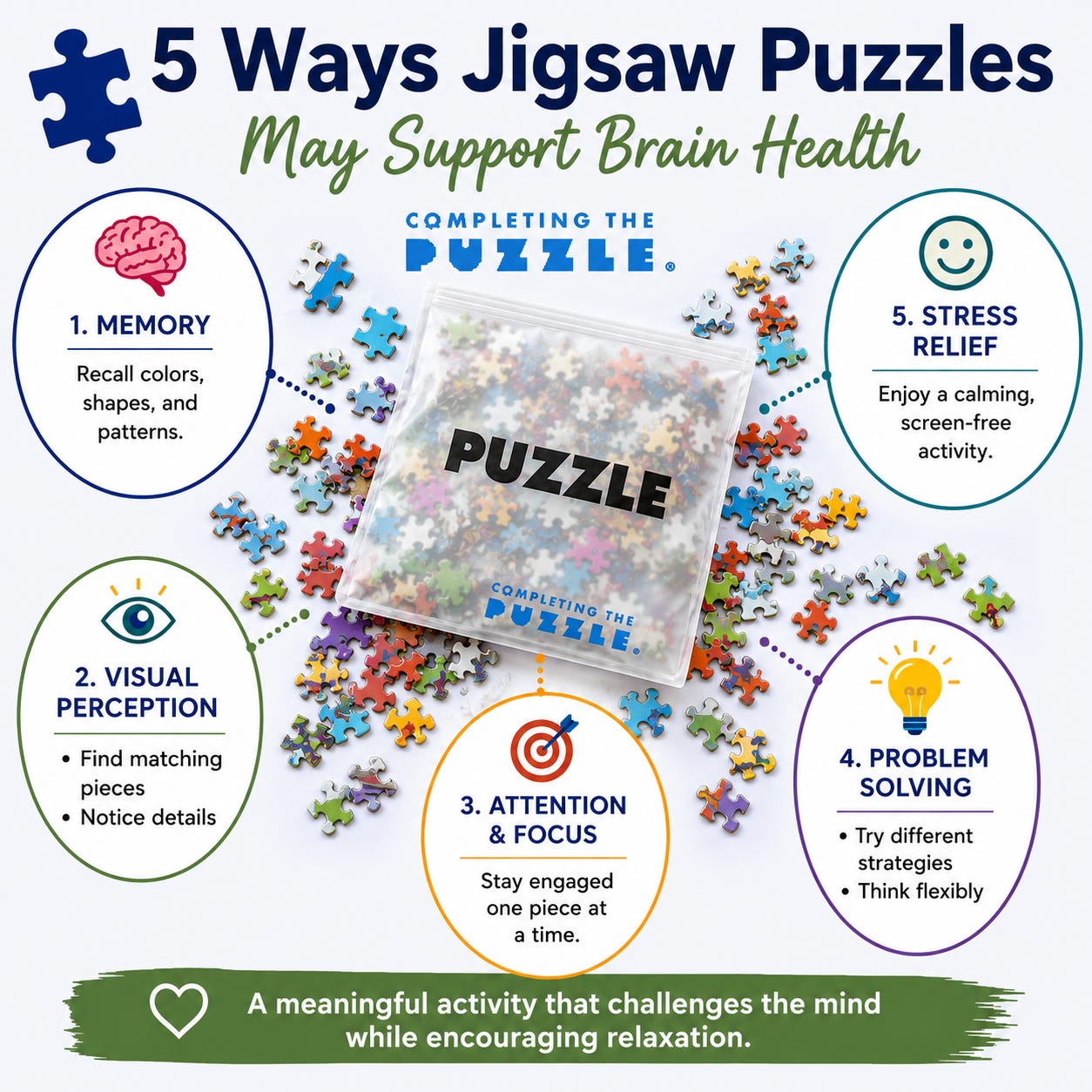
One reason I frequently recommend jigsaw puzzles is that they encourage us to use several cognitive skills simultaneously.
As we work through a puzzle, we naturally practice:
- Visual scanning
- Sustained attention
- Problem-solving
- Pattern recognition
- Visual discrimination
- Cognitive flexibility
Instead of focusing on only one mental task, the brain is constantly processing information and making decisions. We compare colors, identify shapes, search for patterns, and determine where pieces belong.
This type of active participation helps keep the mind engaged while doing something enjoyable.
While no single activity can prevent cognitive decline, staying mentally active is an important part of healthy aging. The National Institute on Aging encourages older adults to participate in mentally stimulating activities that support cognitive health. Research also suggests that jigsaw puzzles are one example of these activities. A 2018 study published in Frontiers in Aging Neuroscience found that jigsaw puzzles engage multiple cognitive abilities simultaneously—including visual perception, working memory, reasoning, and mental rotation—and that long-term puzzle participation may contribute to cognitive reserve.
More Than Cognitive Engagement
One of the most overlooked benefits of jigsaw puzzles is the sense of accomplishment they create.
Every correctly placed piece provides immediate positive feedback.
Small successes matter.
For many older adults, especially those experiencing changes in their abilities, completing even a small section of a puzzle can increase confidence and create a sense of purpose.
As occupational therapists, we recognize that meaningful activities are not simply about staying busy. They should provide enjoyment, encourage participation, and support independence whenever possible.
Jigsaw puzzles accomplish all three. This is one reason occupational therapists often recommend meaningful leisure activities that people enjoy and are likely to continue over time.
A Screen-Free Way to Relax
Today’s world is filled with constant notifications, scrolling, and digital distractions.
Jigsaw puzzles offer something different.
They encourage us to slow down, focus on one task at a time, and become immersed in the present moment.
Many people describe puzzling as calming because it allows them to temporarily step away from daily stressors and concentrate on a single meaningful activity.
This type of focused attention can provide a welcome break from screens while promoting relaxation and enjoyment.
Puzzles Bring People Together
Although many people enjoy completing puzzles independently, they also create wonderful opportunities for social connection.
Families often gather around a puzzle during holidays or weekends.
Grandparents work alongside grandchildren.
Residents in senior living communities come together around a shared activity.
Instead of everyone looking at separate screens, puzzles naturally encourage conversation, teamwork, reminiscing, and laughter.
Some of the best conversations happen while searching for just one more piece.
These shared experiences often become just as meaningful as completing the finished picture.
Why Variety Matters
As an occupational therapist, I have learned that one important factor in maintaining participation is novelty.
When activities remain fresh and interesting, people are often more motivated to continue participating.
While there’s certainly nothing wrong with repeating a favorite puzzle, introducing new images, themes, and levels of challenge helps maintain engagement over time.
Different puzzles encourage us to:
- Explore new visual patterns
- Solve different problems
- Adjust our strategies
- Stay curious
Variety helps transform puzzling from a one-time activity into an ongoing hobby.
Choosing the Right Puzzle
Not every puzzle is right for every person.
Occupational therapists often recommend selecting puzzles based on an individual’s interests, vision, experience, and current abilities.
For example:
- Larger pieces may be easier for someone with arthritis or reduced vision.
- Lower piece counts may help reduce frustration for beginners.
- Familiar images may encourage conversation and reminiscing.
- More experienced puzzlers may enjoy greater complexity and challenge.
The best puzzle is the one that provides just enough challenge while remaining enjoyable and achievable.
Why Puzzle Rentals Make Sense
One question I often hear is:
“What do I do with all the puzzles after I finish them?”
Many puzzle enthusiasts eventually run out of storage space.
Closets become filled with puzzle boxes.
Shelves overflow.
Some puzzles sit untouched for years.
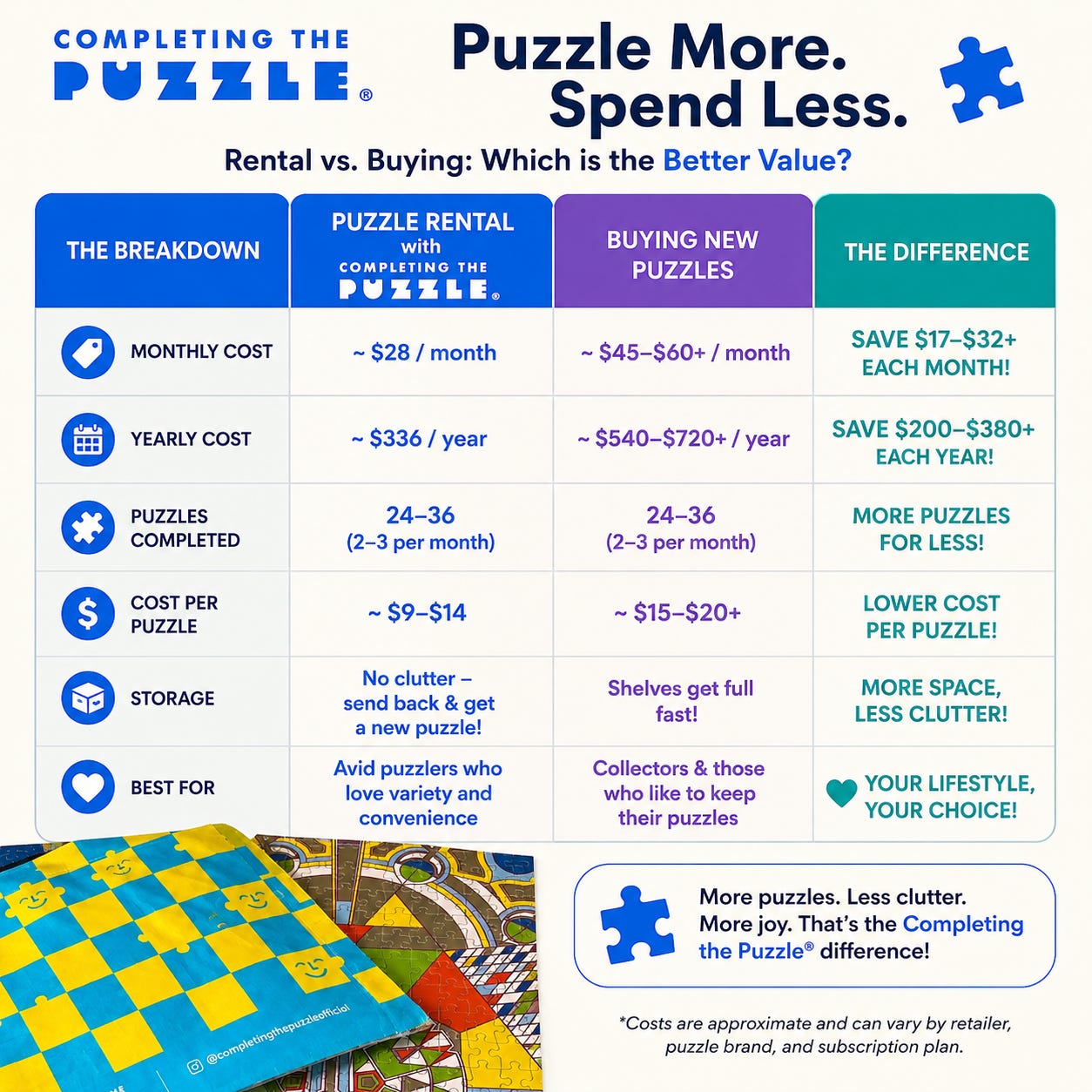
For people who enjoy puzzling regularly, puzzle rental services such as Completing the Puzzle offer a convenient alternative to continually purchasing and storing new puzzles.
Instead of purchasing and storing every puzzle, members can enjoy a fresh challenge, return the completed puzzle, and receive another one.
For many people, this means:
- Less clutter
- More variety
- Lower cost than continually purchasing new puzzles
- An environmentally friendly way to enjoy puzzling
Most importantly, it provides ongoing opportunities for meaningful engagement without filling your home with boxes.
If you are looking for an affordable way to enjoy a variety of puzzles without filling your shelves, explore Completing the Puzzle and discover how puzzle rentals can keep every month fresh, engaging, and fun.It can be an enjoyable way to keep your puzzle collection fresh while reducing clutter.
Why I Partnered with Completing the Puzzle
As an occupational therapist, I’m always looking for practical ways to help people stay engaged in meaningful activities they genuinely enjoy. Personally, I have also found that buying puzzle after puzzle can quickly become expensive, and the boxes eventually take over shelves and closets.
When I discovered Completing the Puzzle, I appreciated that it offered a simple solution: enjoy a new puzzle, complete it, return it, and receive another one. That means more variety, less clutter, and a lower cost than continually purchasing new puzzles.
I chose to partner with Completing the Puzzle because it aligns with the same values I share —encouraging meaningful activities that support healthy aging, relaxation, lifelong learning, and connection. I only partner with products and services that fit naturally with my work as an occupational therapist and that I would feel comfortable recommending to my own family and readers. If you’re someone who loves puzzling but does not want to build a large puzzle collection, I think it is a service worth exploring.
Frequently Asked Questions
Are jigsaw puzzles good for brain health?
Research suggests that jigsaw puzzles engage multiple cognitive abilities, including visual perception, working memory, reasoning, and problem-solving. While no single activity can prevent cognitive decline, staying mentally active through enjoyable activities may support cognitive health as part of an overall healthy lifestyle.
Are jigsaw puzzles good for older adults?
Many older adults enjoy jigsaw puzzles because they encourage concentration, relaxation, and social interaction. Puzzles can also provide a sense of accomplishment and offer opportunities to connect with family, friends, or fellow puzzle enthusiasts.
How often should you do jigsaw puzzles?
There is no recommended frequency. The best approach is to enjoy puzzles regularly as part of a healthy lifestyle that includes physical activity, social engagement, and other mentally stimulating activities.
What if I don’t have room to store lots of puzzles?
If you enjoy completing new puzzles but do not want to fill your shelves with puzzle boxes, a monthly puzzle rental service can be a convenient option. Learn How Completing the Puzzle Works to see how you can enjoy a fresh puzzle each month without the clutter.
Final Thoughts
Healthy aging is not about finding one magic activity.
It’s about filling our days with meaningful experiences that encourage participation, enjoyment, learning, and connection.
Jigsaw puzzles are one example of an activity that may support brain health by encouraging attention, visual scanning, problem-solving, and meaningful leisure. They can also create opportunities to connect with others and enjoy regular mental stimulation through new challenges.
Whether you are a lifelong puzzle enthusiast or trying your very first puzzle, it is never too late to discover the satisfaction that comes from placing that final piece.
Ready for a Fresh Challenge?
If you have been thinking about trying a puzzle rental service, Completing the Puzzle offers a convenient way to enjoy new puzzles without the clutter of buying and storing dozens of boxes. Whether you’re puzzling for relaxation, healthy aging, or simply because you love the challenge, it may be worth exploring. Looking for a thoughtful gift? Completing the Puzzle Gift Cards are a wonderful option for puzzle lovers, older adults, caregivers, teachers, and anyone who enjoys a relaxing, screen-free hobby.
Here’s to staying curious, connected, and engaged—one puzzle at a time.
Learn More
If you’d like to learn more about healthy aging, meaningful activities, and the research behind jigsaw puzzles, explore these trusted resources:
• National Institute on Aging (NIA) Healthy aging, brain health, and mentally stimulating activities.
• American Occupational Therapy Association (AOTA) Meaningful activities, healthy aging, and occupational therapy.
• Jigsaw Puzzling Taps Multiple Cognitive Abilities and Is a Potential Protective Factor for Cognitive Aging. Fissler, P., Küster, O., Schlee, W., & Kolassa, I.-T. (2018). Frontiers in Aging Neuroscience.
Disclosure: This article was created as part of a paid collaboration with Completing the Puzzle. The opinions expressed are my own and are based on my professional experience as an occupational therapist.
About the Author
Kimberly Orlando, MOT, OTR/L, is an occupational therapist with 25 years of clinical experience across hospital, home health, skilled nursing, and community-based settings. She is passionate about helping older adults, caregivers, and families discover meaningful activities that support engagement, independence, and quality of life. Through her work as an educator and content creator, Kimberly shares practical strategies for healthy aging, cognitive wellness, and purposeful living.
Disclaimer: The information shared by Sunny by Kimberly is for educational purposes only and is based on my experience as an occupational therapist and family caregiver. It is not intended to replace individualized medical, occupational therapy, or healthcare advice. Always consult your healthcare provider regarding your specific situation.
Learn more at sunnybykimberly.com


